
Sport News
Kalshi Clone Development vs Custom Prediction Market Development
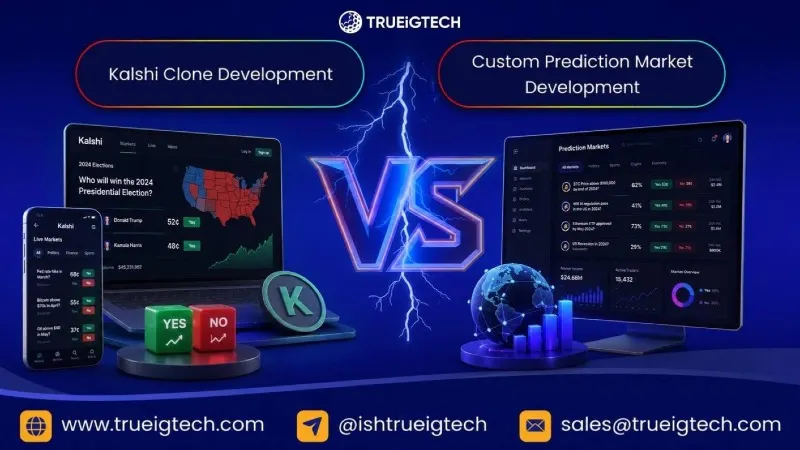
Over the past year, we've noticed an interesting shift in conversations around prediction markets. Founders are no longer asking whether the market is ready. That question has largely been answered. With platforms like Kalshi moving into new verticals such as healthcare forecasting and continuing to expand the scope of event-based trading, prediction markets have clearly entered a new stage of maturity.
The discussion has become far more practical.
"Should we build something similar to Kalshi, or should we invest in our own product architecture from day one?"
For teams evaluating a Kalshi clone script, that sounds like a straightforward choice. Clone solutions promise a faster launch, lower upfront costs, and a familiar trading experience. On paper, it's hard to argue with that.
But software decisions rarely play out on paper.
What looks like the quickest route to market today can become the biggest obstacle six months after launch. The difference usually isn't the interface. It's what sits underneath it.
The First Conversation Shouldn't Be About Features
One mistake we see repeatedly is starting with a feature checklist.
Order book? Check.
Wallet? Check.
Admin panel? Check.
Those are important, but they're not what determines whether a platform succeeds.
A better starting point is understanding the business you're trying to build.
Will your platform focus on sports? Financial events? Elections? AI forecasting? Internal enterprise predictions? Each direction places different demands on the product. Settlement rules change. Liquidity behaves differently. Compliance requirements evolve. Even the way operators manage markets behind the scenes starts to look different.
That's why experienced product teams spend more time discussing architecture than screens.
Where a Clone Makes Perfect Sense
There's a tendency to treat clone solutions as a compromise.
That's not always fair.
If your objective is to validate a business idea, attract early users, or demonstrate a working platform to investors, a clone can be the smartest decision you make.
You reduce engineering time.
You shorten your path to market.
Most importantly, you start learning from real users instead of assumptions.
For an early-stage company, those advantages often outweigh the limitations.
Where Things Usually Start to Change
The interesting part isn't launch day.
It's what happens after launch.
Your first few dozen markets perform well. Operators begin requesting new contract types. Marketing wants seasonal campaigns. Compliance asks for additional reporting. Partners need API access. Your product roadmap starts growing faster than the software itself.
That's when architecture becomes visible.
Many businesses discover they aren't rebuilding because the clone stopped working. They're rebuilding because it stopped adapting.
We've seen teams spend months extending administrative workflows, modifying settlement logic, or introducing market categories that weren't part of the original design. None of those requests sound dramatic on their own. Together, they become expensive.
Clone vs Custom: The Decision in Practice
|
What You're Planning For |
Kalshi Clone |
Custom Platform |
|
MVP or proof of concept |
Excellent fit |
Usually unnecessary |
|
Fast market entry |
Strong advantage |
Longer timeline |
|
Unique event contract models |
Limited flexibility |
Built around your requirements |
|
Long-term product roadmap |
Requires ongoing modification |
Easier to evolve |
|
Multi-region expansion |
Depends on original architecture |
Designed with scalability in mind |
|
Operator workflow customization |
Moderate |
Extensive |
|
Enterprise integrations |
Can become restrictive |
API-first approach |
|
Product differentiation |
Incremental |
Complete ownership |
The point isn't that one approach is better than the other.
It's that they're solving different problems.
The Cost Nobody Includes in Early Estimates
Development budgets usually focus on the first release.
In reality, the second year tells you whether the original technical decisions were good ones.
Think about the requests that naturally arrive as a platform grows:
-
Adding new prediction categories
-
Supporting external market data providers
-
Building mobile applications
-
Creating partner APIs
-
Expanding reporting tools
-
Introducing AI-assisted market creation
None of these are unusual.
The question is whether your architecture welcomes those additions or fights them.
That's why experienced product teams often look beyond launch costs and ask a different question:
"How expensive will this platform be to improve?"
It's a much harder question to answer, but usually the more valuable one.
Build for the Business You Want to Become
Every startup wants to launch quickly.
That's understandable.
But successful prediction market companies don't win because they shipped first. They win because they continue shipping after everyone else slows down.
The platform needs to evolve as regulations change, new market categories emerge, and customer expectations increase. A product that cannot adapt eventually becomes the bottleneck.
That reality has become even more important as prediction markets continue moving into mainstream finance, media, sports, and enterprise forecasting, attracting larger audiences and institutional attention.
Final Thoughts
The clone-versus-custom debate doesn't have a universal answer, and it shouldn't.
A clone is often the right decision when speed, validation, and early market entry are the priority. Custom development becomes the stronger investment when the platform itself is expected to become a long-term competitive advantage.
When comparing Prediction Market Platform Providers, look beyond screenshots and feature lists. Ask how they approach exchange architecture, settlement engines, compliance, scalability, and future product evolution. Those conversations reveal far more than a demo ever will.
At TRUEPREDiCT, that's exactly how we approach prediction market development. Whether a client begins with a Kalshi-inspired platform or a fully custom solution, the objective is the same: build technology that doesn't just launch successfully, but continues to support the business as it grows.