
Sport News
Bongdalu – How to Read Football Standings and League Tables
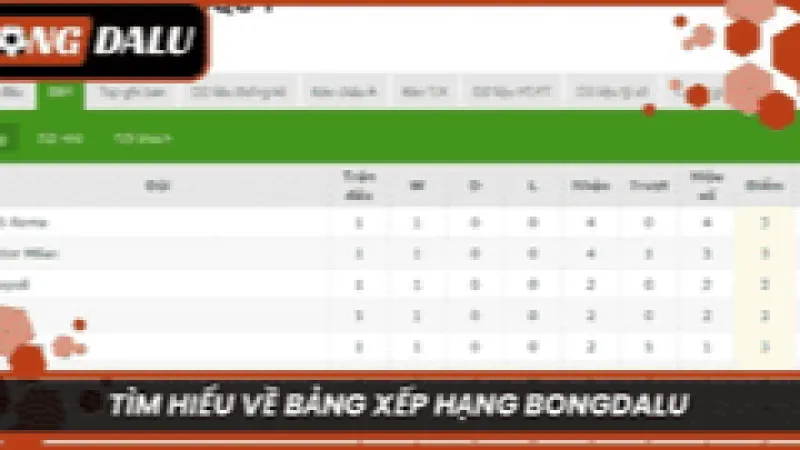
League tables are among the most important sources of information for football supporters. Within a few seconds, a table can show which clubs are competing for the championship, which teams are pursuing continental qualification, and which sides face the threat of relegation.Bongdalu is one of the football-related resources users may encounter while searching for standings and match data.
Although league tables appear straightforward, understanding every column provides much more information than simply looking at first and last place.
What Is a Football League Table?

A league table organizes teams according to their results during a competition.
The most common information includes matches played, wins, draws, defeats, goals scored, goals conceded, goal difference, and total points.
In many competitions, teams receive three points for a victory and one for a draw. Defeats normally provide no points.
However, competition-specific rules should always be checked.
Following Bảng xếp hạng

Readers can use sections such asBảng xếp hạng when they want to review the current positions of teams in a competition.
Standings are particularly valuable because they summarize many matches in a compact format.
Instead of reading every individual result, a user can look at the table and immediately understand the broad competitive situation.
Matches Played
The number of matches played is an essential column.
Two teams may have the same number of points while having played a different number of fixtures. The club with fewer matches could potentially move ahead when it completes its games in hand.
For this reason, comparing points without checking matches played can create a misleading impression.
Wins, Draws and Losses

The win, draw, and loss columns explain how a team's points were accumulated.
Two clubs can have similar totals but very different profiles. One might win frequently while also losing many matches, whereas another may be difficult to defeat but draw often.
These patterns can reveal useful information about consistency and playing style.
Understanding Goal Difference
Goal difference is calculated by subtracting goals conceded from goals scored.
If a club scores 40 goals and concedes 25, its goal difference is +15.
This statistic is important because many competitions use it as a tiebreaker when teams finish level on points.
A strong positive goal difference can also provide a quick indication of overall performance.
Goals Scored
The goals-for column reflects attacking output across the competition.
Teams near the top of the scoring rankings may possess effective attacking systems, high-quality forwards, or both.
However, scoring many goals does not automatically guarantee first place. Defensive performance also matters, and a team can lose points despite having an excellent attack.
Goals Conceded
Goals against provide a basic measure of defensive results.
Teams challenging for championships frequently combine attacking strength with defensive consistency.
Nevertheless, the number should be interpreted alongside other information. A low total may result from excellent defending, strong goalkeeping, tactical caution, or a combination of factors.
Qualification Positions
League tables often contain zones associated with qualification for other competitions.
Depending on the league, high-ranking teams may qualify for continental tournaments or championship playoffs.
The exact rules can vary by season and competition, so users should verify the qualification structure instead of assuming the same positions always have identical meaning.
Understanding the Relegation Zone
At the opposite end of the standings is the relegation battle.
Teams occupying the lowest positions may be demoted to a lower division when the season concludes. Some competitions also use relegation playoffs.
This makes matches involving bottom-ranked clubs particularly important late in the season.
A single victory can sometimes change several positions when teams are separated by only a few points.
Games in Hand
A table can look significantly different when teams have played unequal numbers of matches.
Suppose Team A has 50 points after 25 matches and Team B has 47 after 23. Team A currently ranks higher, but Team B has two opportunities to collect additional points.
Games in hand should therefore be considered when assessing the true state of a title race or relegation battle.
Form Versus League Position
The league table represents performance accumulated across the season, while recent form focuses on a shorter period.
A club may remain high in the standings despite entering a difficult run of results. Conversely, a lower-ranked team may be improving rapidly after changing its coach or signing new players.
Combining standings with recent form can provide a more complete picture.
Why Tables Change Quickly
Early in a season, a single result can cause substantial movement because teams have accumulated relatively few points.
Later, rankings often become more stable, although close races can continue until the final round.
Postponed matches can also temporarily distort the table by leaving clubs with different numbers of fixtures played.
Head-to-Head Tiebreakers
Not every league uses goal difference as its first tiebreaker.
Some competitions prioritize head-to-head results, while others may use goals scored or additional criteria.
This becomes particularly important near the end of a season when teams are level on points.
Readers should consult the rules of the specific competition when precise ranking implications matter.
Standings Do Not Guarantee Future Results
A team ranked first is generally performing better across the season than one near the bottom, but this does not guarantee victory in an individual match.
Football outcomes are influenced by injuries, suspensions, tactics, motivation, venue, fatigue, and random events.
League position should therefore be treated as one analytical factor rather than a prediction by itself.
Following Multiple Competitions
Football supporters may follow several leagues simultaneously.
Organized standings make it easier to compare title races, qualification battles, and relegation situations without searching separately for every club.
Users should nevertheless confirm that they are viewing the correct season and competition, particularly when historical tables are also available.
Conclusion
Bongdalu can be used as a football-information reference for readers interested in standings and competition data. A league table contains much more than a list of teams: points, matches played, goal difference, scoring records, qualification zones, and relegation positions all tell part of the season's story.
Reading these elements together provides a clearer understanding of how a competition is developing.
Standings are excellent for measuring what teams have achieved so far, but they should not be treated as guarantees of future match results. Football can change quickly, and every new fixture adds another piece to the season.